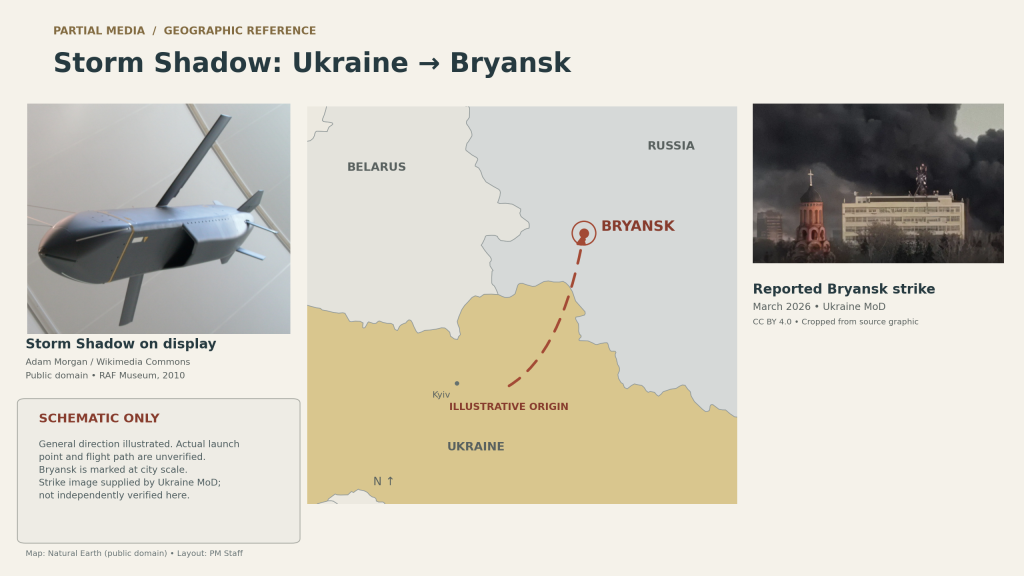
Ukraine’s use of the British-French Storm Shadow/SCALP cruise missile has extended its ability to strike fixed targets inside Russia. Ukraine’s Defence Ministry attributed the March 10, 2026 attack on the Kremniy El microelectronics plant in Bryansk to Storm Shadow and reported damage to production facilities. That is an official Ukrainian claim, not an independently audited damage assessment. The weapon’s significance lies in precision against selected infrastructure; public footage alone cannot establish the resulting effect on Russian weapons production.
Source passage translated using AI; it may not be fully accurate.
MBDA lists Storm Shadow at 5.10 meters long and approximately 1,300 kilograms, with a published range exceeding 250 kilometers. Ukraine’s Defence Ministry describes the supplied version as reaching up to 300 kilometers with a roughly 450-kilogram warhead. The Ukrainian source passage was translated using AI and may not be fully accurate. MBDA describes inertial navigation, GPS and terrain referencing, followed by infrared image matching near the target. Its tandem penetrator is intended for protected fixed targets. These specifications explain the design; they do not independently verify combat accuracy, resistance to interference or the range of every missile delivered to Ukraine.
Social-media reporting offers useful but incomplete evidence. In a November 20, 2024 post about Kursk, the Russian pro-war Telegram channel Two Majors acknowledged that reported ground explosions contradicted claims that every Storm Shadow had been intercepted. The channel is not authenticated here as a military unit. Separately, Ukraine’s General Staff published a March 2026 Bryansk strike claim crediting aerial reconnaissance to the Raid unmanned-systems regiment. These posts establish what their authors claimed. This article relies on published reporting and accessible post text, without independently authenticating or conducting frame-by-frame analysis of the original videos. The Russian-language commentary was translated using AI and may not be fully accurate. The General Staff also published an English version.
A more recent case underscores the same limits. The Kyiv Independent reported that Ukraine’s General Staff confirmed an October 23 strike on Oryol’s Proton-Electrotex electronics plant, while the regional governor acknowledged an enterprise had been targeted. The newsroom also cited ASTRA’s site identification. Its report does not independently establish which missile caused each impact or quantify the effect on Russian missile output. This is a separate October case, not the March Bryansk event shown in the article’s illustrative collage. Farrell’s report, updated October 24.
Russian counterparts: specifications and limits
| Missile | Approximate length | Public range figure | Comparison |
|---|---|---|---|
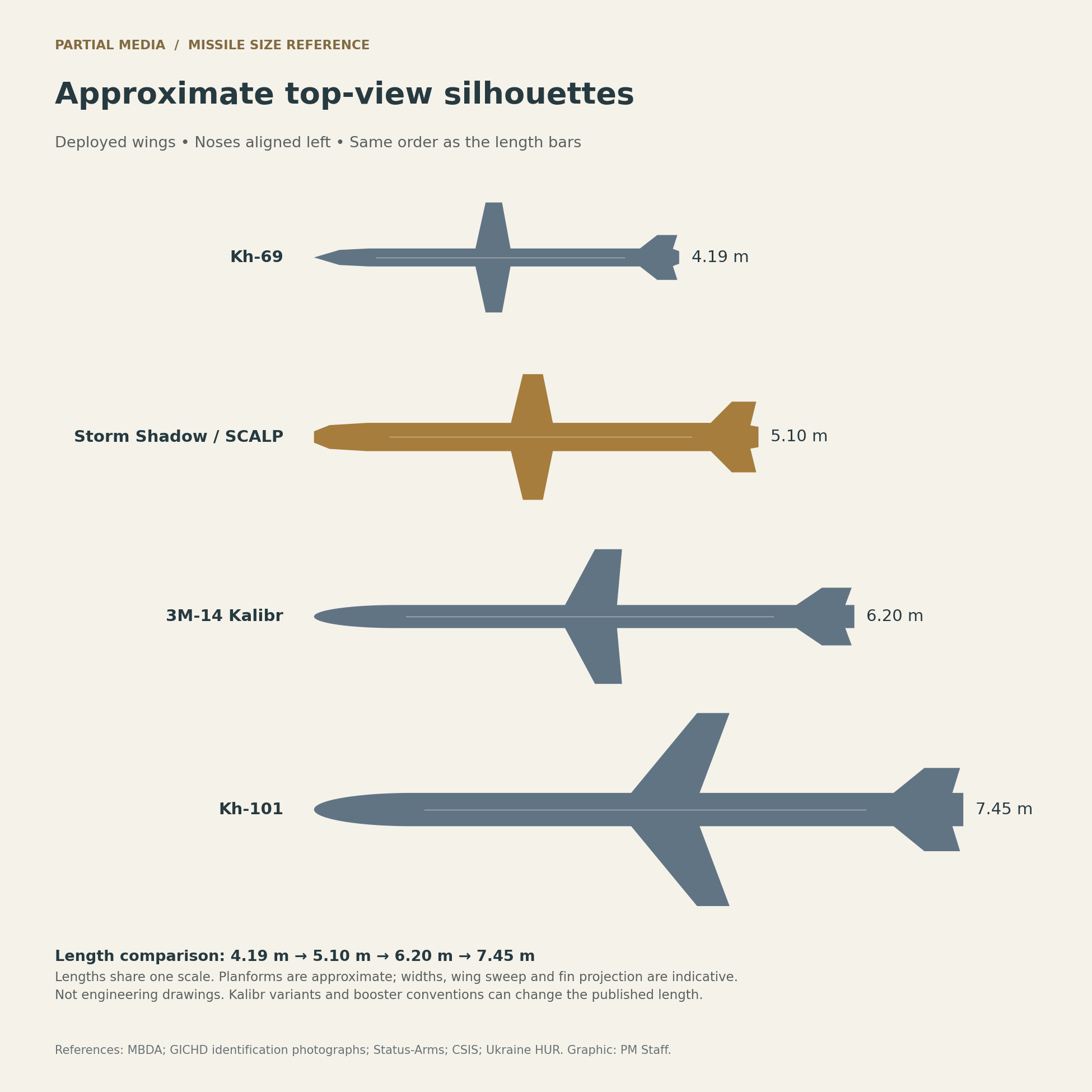
| Storm Shadow / SCALP | 5.10 m | Over 250 km; Ukraine says up to 300 km for its supplied version | Air-launched; fixed-target precision strike; infrared terminal image matching |
| Kh-69 | 4.19 m | 290 km advertised; unofficial reports suggest longer domestic reach | Closest role counterpart; tactical-aircraft carriage; inertial/satellite navigation and electro-optical terminal guidance |
| Kh-101 | 7.45 m | Ukraine’s HUR lists up to 5,500 km; published estimates vary | Larger air-launched strategic cruise missile; optical and satellite-navigation equipment documented by HUR |
| 3M-14 Kalibr | 6.20 m, representative CSIS figure | Approximately 1,500–2,500 km, CSIS estimate | Ship/submarine-launched land-attack missile; distinguish it from other Kalibr-family weapons |
Kh-69 exhibition specifications were translated using AI from Russian and may not be fully accurate. Ukrainian Storm Shadow specifications were translated using AI and may not be fully accurate. All ranges retain their source and variant limitations.
Editorial Opinion
Speculation: the reported concentration of Storm Shadow impacts is consistent with effective guidance against fixed locations, but does not establish a numerical accuracy figure or destruction below ground. Kh-69 appears to be a credible Russian counterpart: Defense Express attributed the April 2024 Trypilska power-station attack to it, citing unnamed sources and recovered fragments, and reported a roughly 400-kilometer launch distance. That range remains an unofficial estimate. Because the wider attack involved several weapon types, the plant’s destruction cannot be assigned entirely to Kh-69 or used to prove its superiority. Kh-101 and Kalibr offer substantially longer published reach, which alone says nothing about their relative accuracy.
Assessment: Ukraine’s Defence Ministry describes Storm Shadow as having almost 100% effectiveness, but its March summary provides no independently reproducible denominator or combat-test dataset. That claim therefore remains an attributed assertion. Storm Shadow has a credible record of reported impacts, but a reliable comparative success-rate ranking is unavailable from the evidence reviewed. Videos selected for publication omit failed launches, interceptions and unpublished outcomes. A large fireball can include secondary explosions; visible damage does not establish permanent loss of production or confirmed casualties. Guidance-system specifications also cannot be inferred from an explosion. The defensible conclusion is that these weapons can cause serious damage when they reach their targets, while claims of near-perfect effectiveness or precise comparative interception rates exceed what the available clips and unofficial reports establish.
References
- Defence Intelligence of Ukraine. (n.d.). Kh-101 missile. Official Ukrainian technical assessment.
- Defense Express. (2024, April 12). The Russians used the latest Kh-69 missiles to attack the Trypilska TPP. Attribution and extended-range claim rely on the outlet’s unnamed sources.
- Farrell, F. (2026, October 24). Ukrainian forces strike Oryol electronics plant, General Staff confirms, drone attacks shut down Moscow airports. The Kyiv Independent.
- General Staff of the Armed Forces of Ukraine. (2026, March 10). Bryansk strike statement [Telegram post].
- Geneva International Centre for Humanitarian Demining. (n.d.). Explosive Ordnance Guide for Ukraine (3rd ed., pp. 226, 228–229). Used for visual identification references; the length comparison retains the figures attributed in the table.
- MBDA. (2019). Storm Shadow/SCALP: Illustrated technical datasheet.
- MBDA. (n.d.). Storm Shadow / SCALP.
- Ministry of Defence of Ukraine. (2026, March 11). Що відомо про ракети Storm Shadow, якими уражено «Кремній Ел» – виробника мікросхем для «іскандерів» [What is known about the Storm Shadow missiles used to strike Kremniy El, a maker of chips for Iskander missiles]. Ukrainian-language source. Passage and title translated using AI; they may not be fully accurate.
- Missile Defense Project. (2024, April 23). 3M-14 Kalibr (SS-N-30A). Center for Strategic and International Studies.
- Status-Arms. (2024, August 16). На форуме «Армия-2024» представлена ракета Х-69 с новой схемой окраски [Kh-69 displayed at Army-2024 with new paint scheme]. Russian-language exhibition reporting. Specifications and title translated using AI; they may not be fully accurate.
- Two Majors. (2024, November 20). Kursk Storm Shadow strike commentary [Telegram post; Russian-language source]. Passage and descriptive title translated using AI; they may not be fully accurate.
Featured collage: Adam Morgan’s Storm Shadow museum photograph, February 2010, released into the public domain; Ukraine Ministry of Defence’s March 11, 2026 image of the reported Bryansk strike, CC BY 4.0; and Natural Earth public-domain map data. Images resized and assembled by PM Staff for geographic illustration. The schematic map is not a verified missile flight path. The archive photographs do not depict the October Oryol strike. The separate approximate planform comparison is a PM Staff explanatory graphic, not authenticated hardware photography.
