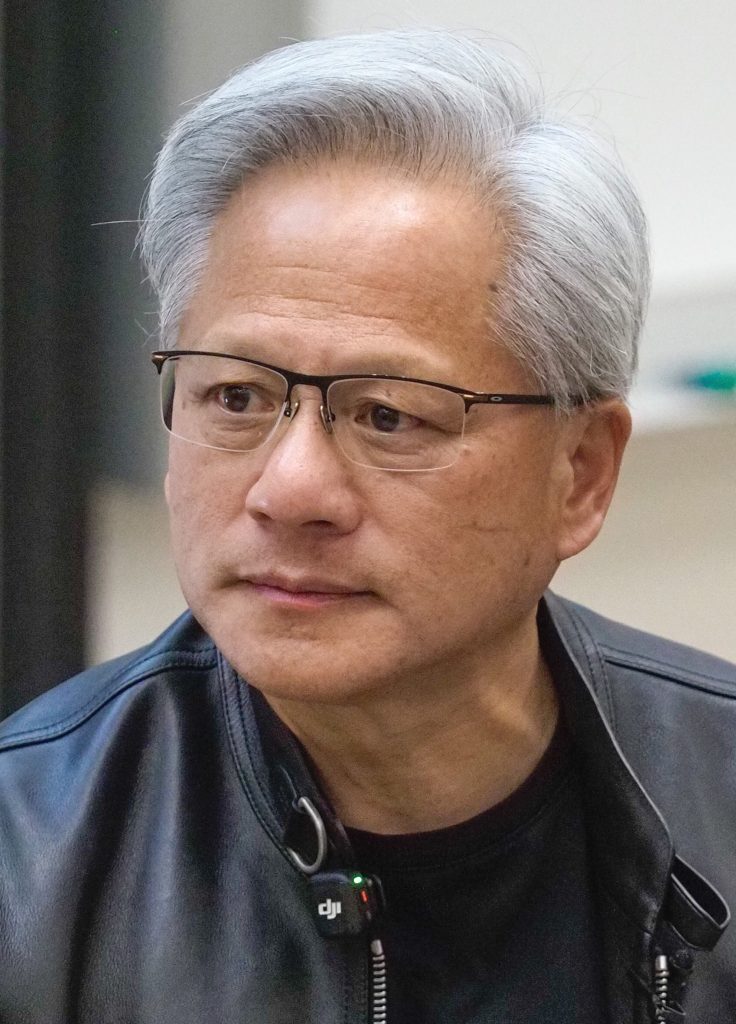
Archive photo. Jensen Huang at a Stanford University fireside chat, April 30, 2026. Photo by Anders Eidesvik, cropped and brightened by Wikimedia Commons contributor Dy0ykidd. Source · CC BY 4.0.

Jensen Huang spent 33 years leading Nvidia, the company he co-founded in 1993. Its graphics processors, designed to perform many calculations in parallel, became central to training and running artificial intelligence models. Now Nvidia is searching for a new chief executive as investigators and lawmakers examine whether some of its advanced chips reached China without the required U.S. authorization.
Nvidia told the Securities and Exchange Commission that its board accepted Huang’s resignation as chief executive, president and director on November 11, effective immediately. It announced the change November 12 and named Chief Financial Officer Colette Kress interim CEO. Reuters reported that directors met to consider removing Huang, and The Wall Street Journal reported that the board was preparing to oust him. The public filing gives no reason for the resignation.
What Huang acknowledged and what remains disputed
Huang told employees November 8 that he had been unfaithful to his wife. His public message named no partner. The Associated Press reported that he acknowledged an intimate relationship with a business executive to Nvidia’s board. Reporting identified her as Alice Huang, also known as Huang Le, a former CEO and chair of Singapore-based Nvidia cloud partner Megaspeed International. The two are unrelated.
The New York Times reported that U.S. officials assessed Alice Huang had passed information to Beijing. Reuters could not independently verify the claim, which Beijing denied. CNN reported that officials had yet to conclude that she knowingly passed information to Chinese intelligence. Nvidia opened an independent inquiry and retained former federal prosecutor Joon H. Kim and his law firm. The board said at the outset that it had no reason to believe national-security information or company trade secrets had been compromised.
The Times separately reported, citing five people who worked at Nvidia, that Huang had an affair with Kimberly Powell, its vice president of healthcare and, according to the Times, his direct report. Reuters later reported, citing two people familiar with the matter, that he had an intimate relationship with a different Nvidia employee, whom it did not name. The reports supply no evidence that either employee helped divert chips or disclose controlled technology.
What the chip records show
Singapore says its police and customs authorities opened an inquiry in February 2025 into potential false declarations involving server purchases. Some servers passed through Singapore to Malaysia. Police were examining whether the equipment went on to another destination. U.S. export-control officials conducted a voluntary post-shipment check at Megaspeed in June 2025. Singapore said it had insufficient evidence to establish that Alice Huang committed the suspected declaration offenses. Police separately said she gave inaccurate information to downplay her role, issued a warning and barred her from re-entering. The ministry did not investigate her for espionage. Megaspeed says it cooperated with U.S. inspections and retained outside counsel to oversee an inventory of its graphics processors.
Reuters traced Megaspeed from its incorporation as 7Road International to ownership by Singapore-based Swiftdata. Researchers at C4ADS could not identify Swiftdata’s ultimate controller. Reuters also examined records showing H100 processors and related Nvidia hardware entering Indonesia through suppliers including Gigabyte’s Giga Computing. Separate records trace financing from Alibaba subsidiary Apex Enterprise Solutions to Speedmatrix, Megaspeed’s Malaysian unit. These records identify suppliers and financing. The ultimate end users and authorization for specific onward shipments remain open questions.
Singapore identified Supermicro as a relevant server supplier. Bloomberg reported that U.S. investigators were examining whether companies linked to Alice Huang helped divert Supermicro equipment. The company said it responded to and cooperated with authorities. A separate U.S. indictment unsealed in March accused three individuals of conspiring to divert AI servers to China. Neither Huang was charged in that indictment.
The Information reported that Shanghai Century Litong imported about 240,000 Nvidia chips worth at least $7.5 billion into China since 2023. Litong said it obtained its resources through compliant channels and denied doing business with Alice Huang. The same outlet reported that entities linked to Litong and its parent, Jiangsu Lettall Electronics, invested in DeepSeek. That financing report does not identify which chips DeepSeek received or under what authorization. CNBC, citing corporate research by Tesari, separately traced an indirect link from Alice Huang’s interest in Shanghai Hexi through Century Longteng to Huawei Cloud. That ownership and business chain does not establish a transfer of Nvidia hardware or information to Huawei.
Where U.S. export law could apply
The Export Administration Regulations can cover an initial export, an onward shipment or certain changes in end use or end user abroad. Investigators would need to identify the specific chips or servers, the license requirements in force at the time, and who received or used them. The Commerce Department began reviewing applications for H200 exports to China case by case in January 2026 under specified conditions. A lawful sale to one customer does not establish authorization for a later transfer to another.
Huang could face personal exposure if evidence showed that he caused or approved a prohibited transaction, or engaged in covered dealings with equipment while knowing of a violation. The regulations can treat conscious disregard or deliberate avoidance of facts as evidence of knowledge. An unauthorized disclosure of controlled technology could raise a separate issue without a hardware shipment. The records reviewed identify no specific unlawful order personally approved by Huang, no controlled data he personally disclosed, and no public export-control charge against him. Criminal liability would also turn on the applicable statutory requirements for willfulness.
Editorial Opinion
Nvidia’s board should establish whether its compliance staff could stop a sale when the chief executive had a personal connection to the customer. That requires matching chip serial numbers and shipment records to actual end users, then checking what decision-makers knew before the transactions. Congress has asked the administration to preserve its records. Nvidia’s independent inquiry should explain what the company can establish about its own decisions and where the evidence runs out.
References
Associated Press. (2026, November 8). Nvidia investigates whether CEO Jensen Huang was targeted by Chinese spy with whom he had an affair.
Bureau of Industry and Security. (n.d.). EAR Part 734, Part 736, Part 764, and Part 772.
Bureau of Industry and Security. (2026, January 13). Semiconductor export license review policy.
C4ADS. (2026). Covert compute.
CNN. (2026, November 12). Reporting on the U.S. intelligence assessment. KTVZ.
Nvidia. (2026, November 8). Huang’s employee message and board statement.
Nvidia. (2026, November 10). Independent directors’ statement.
Nvidia. (2026, November 12). Form 8-K and CEO transition announcement.
Reuters. (2026, November 10–12). Reports on Alice Huang and Megaspeed, Nvidia board deliberations, an unnamed employee, and Megaspeed’s response.
Singapore Ministry of Home Affairs. (2026, November 12). Singapore’s investigations into Alice Huang and Megaspeed.
Additional reporting from The New York Times, The Wall Street Journal, The Straits Times, Bloomberg, The Information on the chip imports and DeepSeek financing, and CNBC via CNBC-TV18.
U.S. Department of Justice. (2026, March 19). Three charged with conspiring to unlawfully divert U.S. artificial intelligence technology to China.
Warren, E., & Coons, C. (2026, November 11). Request to preserve export-control records. U.S. Senate.
Have a factual correction or website problem? Contact PartialMedia with the article link, disputed passage and supporting source.
Discussion
Comments load automatically through Disqus. This connects to Disqus and its partners, which may use cookies and process your IP address and browser information. Disqus privacy policy.