Legal context — October 31, 2026
Fox News reporter Charles Creitz’s October 31 interviews with John Yoo and Cully Stimson identify two different congressional powers: judging whether a member-elect meets constitutional qualifications and expelling a seated member. Their discussion describes possible legal disputes; the report does not establish that Omar has lost citizenship or that the Supreme Court has taken an Omar case. (Creitz, 2026)
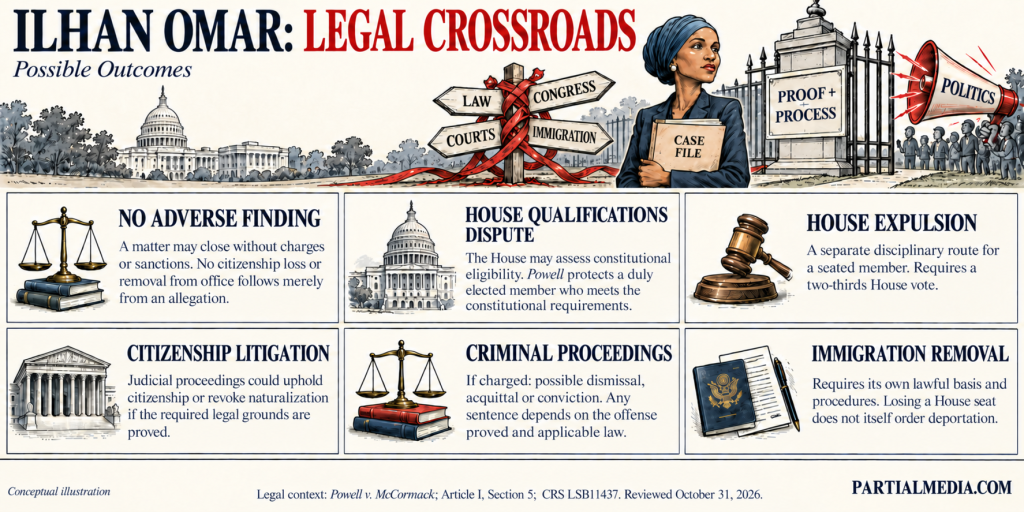
In Powell v. McCormack (1969), the Supreme Court held that the House could not exclude a duly elected member who met the Constitution’s membership requirements. Citizenship is one of those requirements. Expulsion is a separate House disciplinary power requiring a two-thirds vote; presidential demands do not themselves remove a representative. (Constitution Annotated)
Citizenship status and criminal responsibility also require separate analysis. The Congressional Research Service’s denaturalization overview describes judicial proceedings and a heightened government burden of proof in civil cases. Some statutory provisions can affect citizenship derived through a parent. Applying them here would require the actual citizenship records, applicable law and established facts; a reported family discrepancy or an expert’s conditional scenario is not that determination.
Open the full-size outcome graphic.
Possible outcomes
Which path is relevant depends on established facts and the applicable procedure.
- NO ADVERSE FINDING: A matter may close without charges or sanctions. An allegation does not automatically cause loss of citizenship or removal from office.
- HOUSE QUALIFICATIONS DISPUTE: The House may assess constitutional eligibility. Powell protects a duly elected member who meets constitutional requirements; a predicted January confrontation is not an announced proceeding.
- HOUSE EXPULSION: A separate disciplinary route for a seated member requires a two-thirds House vote. It does not require a prior criminal conviction and does not itself revoke citizenship.
- CITIZENSHIP LITIGATION: Judicial proceedings could uphold citizenship or revoke naturalization if the required grounds are proved. Civil denaturalization carries a heightened government burden of proof. Parent-derived citizenship questions require the actual records and applicable law.
- CRIMINAL PROCEEDINGS: If charges are brought, possibilities include dismissal, acquittal or conviction. Any sentence depends on the offense proved and applicable law. This discussion establishes no new charge or conviction.
- IMMIGRATION REMOVAL: Removal from the United States requires its own lawful basis and procedures. Loss of a House seat does not itself order deportation; denaturalization is not an immediate removal order.
Evidence update — October 30, 2026
FOX 9’s Karen Scullin reported October 28 that a judge kept the search warrant sealed after DOJ opposed disclosure. Her account says no charges had been filed as of that report. It describes the government’s alternate-name assertion but does not establish that assertion as an adjudicated fact. The complete warrant, supporting evidence and any DNA results remain unavailable for this article’s independent examination. A search, an asserted alias and a reported biological comparison each answer different questions; none alone establishes immigration fraud. (Scullin, 2026)
This update adds the warrant-disclosure development; it does not verify the family-relationship allegation discussed in the original opinion below. No new public laboratory finding was verified in this review. Source recheck: October 30, 2026 at 7:47 PM Pacific.
Rep. Ilhan Omar faces renewed questions about her identity following the October 12 federal search of her Washington home. FOX 9, citing Fox News, reported that investigators used a different name in court paperwork. When the local station asked her directly, Omar identified herself as Ilhan Abdullahi Omar. FOX 9 also located a high-school yearbook identifying her as Ilhan Omar at 17. That establishes longstanding public use of the name, but does not resolve the disputed alternate identification. This review did not obtain the complete underlying court filing or identify a public criminal indictment; an alternate name in a filing does not itself prove deception. FOX 9’s reporting.
The documented accountability record remains relevant, but distinct. In 2019, Minnesota’s Campaign Finance and Public Disclosure Board ordered Omar to reimburse her state campaign $3,469.23 and pay a $500 civil penalty. That included disallowed spending for accounting services involving personal tax returns; her attorney acknowledged an issue requiring correction regardless of her candidacy. The board rejected the allegation that the disputed legal payment financed her divorce. Separately, the FEC found no reason to believe campaign funds were converted to personal use in the E Street Group matter. These decisions establish their specific findings, not immigration fraud. Omar denies wrongdoing and calls the current investigation politically motivated.
The DNA component is reported, not publicly demonstrated. The New York Post, citing unnamed sources, says investigators obtained DNA to examine alleged family relationships, including the unproven claim that former husband Ahmed Nur Said Elmi is Omar’s brother. Its reporting disputes an earlier garbage-collection account and leaves collection timing unclear. Omar denies DNA was collected during the home search, saying the inventory contained no toothbrush, comb or similar item. An October 26 congressional letter also mentions DNA, explicitly as a reported development; it is not a laboratory finding or confirmation from investigators. The collection method, comparison samples and any test results remain unverified in the public material reviewed.
How testing could help—and its limits: NIST describes genetic markers used for identity and kinship testing. In general, a laboratory compares DNA profiles and evaluates how strongly they support competing relationship hypotheses, such as siblings versus unrelated people. Applying that principle here is an analytical explanation, not confirmation of the government’s actual testing protocol. Authenticated comparison samples, documented handling and appropriate statistical interpretation would matter. A demonstrated biological relationship could help investigators test statements in immigration records; it would not by itself establish a legal name, an exact birth date, a sham marriage or knowing fraud. Documentary records and evidence of who made which statements would still be necessary.
In an October 26 letter, congressional Democrats led by Pramila Jayapal and other committee leaders denounced the search as political interference. The letter is an argument by Omar’s allies, not a judicial ruling. It also repeats a reported DNA collection; it supplies no laboratory result. Neither a congressional defense nor an investigator’s allegation resolves the underlying evidence.
Editorial Opinion
Public office should provide neither immunity from lawful scrutiny nor a shortcut around constitutional procedure. If a genuine citizenship defect or serious misconduct is proved, the responsible institutions should apply the remedies the law permits. Political demands cannot substitute for a House vote or a court judgment. Criminal culpability and citizenship eligibility are different legal questions: personal intent may matter to a criminal charge, while a citizenship claim turns on the governing acquisition and revocation rules. Neither should be resolved by treating a hypothetical scenario as an established fact.
A conservative commitment to lawful immigration means credible evidence of identity or family-relationship fraud deserves investigation, even when the subject holds congressional office. People who followed immigration rules deserve confidence that deliberate deception carries consequences. Omar’s denial does not settle documentary discrepancies, and prosecutors’ assertions do not settle them either. Public accounts differ about DNA collection: the Post leaves its timing unclear, while Omar denies collection during the home search. Her denial does not establish that no sample was obtained elsewhere, and an unnamed source’s assertion is not a public test result. The government should explain the alternate identification and, when legally appropriate, disclose the basis and limits of any genetic evidence. Equal enforcement requires proving individual responsibility under the applicable law. The public should demand a substantiated case and clear answers rather than treating a reported DNA collection as a verdict.
References
- Christenson, J. (2026, October 19). Feds have DNA evidence that could prove Ilhan Omar wed her brother, committed immigration fraud: Sources. New York Post, republished by AOL. Claims rely on unnamed sources.
- Congressional Research Service. (n.d.). Overview of Expulsion Clause. In Constitution Annotated. Essay reproduced by the Legal Information Institute.
- Congressional Research Service. (2026, June 2). Denaturalization: A brief overview of the current legal framework (LSB11437). Report reproduced by EveryCRSReport.
- Creitz, C. (2026, October 31). Trump push to oust Omar faces historic Supreme Court test, but legal experts see ‘uncharted’ twist. Fox News. Original interviews and analysis.
- Federal Election Commission. (2021). Matter under review 7639.
- Forensic Science Regulator. (2026, February 24). Autosomal DNA relationship testing. UK scientific guidance, cited for general principles rather than U.S. legal requirements or this investigation’s protocol.
- FOX 9 Staff. (2026, October 23). Rep. Ilhan Omar clarifies full name after federal raid, alias allegation.
- Gaskins, K. (2026, October 22). Ilhan Omar responds to immigration fraud allegations after federal search of home. The National News Desk/WLOS.
- Members of Congress. (2026, October 26). Letter to Attorney General Blanche and Secretary Mullin regarding the Omar investigation. Hosted by Rep. Pramila Jayapal. The letter opposes the search and repeats media reporting about DNA.
- Minnesota Campaign Finance and Public Disclosure Board. (2019, June 6). Findings, conclusions, and order regarding the Neighbors for Ilhan (Omar) committee.
- National Institute of Standards and Technology. (2025, July 9). Forensic genetics.
- Powell v. McCormack, 395 U.S. 486 (1969). Supreme Court opinion reproduced by Justia.
- Scullin, K. (2026, October 28). Ilhan Omar investigation: Search warrant stays sealed after DOJ filing. FOX 9. Warrant-disclosure reporting.
Have a factual correction or website problem? Contact PartialMedia with the article link, disputed passage and supporting source.
Discussion
Comments load automatically through Disqus. This connects to Disqus and its partners, which may use cookies and process your IP address and browser information. Disqus privacy policy.