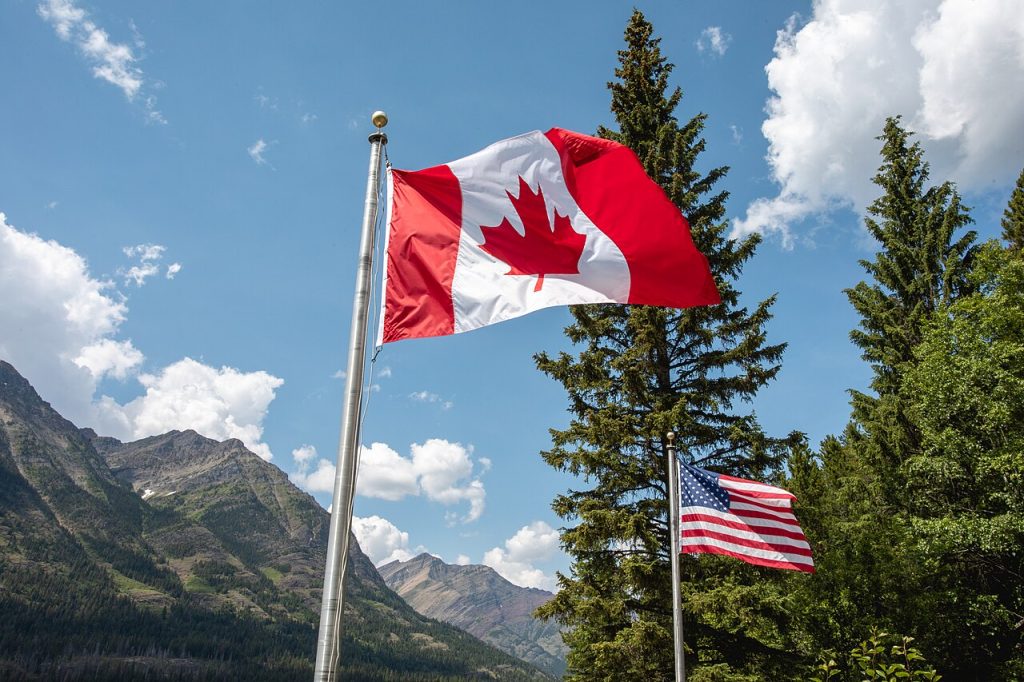
Illustrative archive photograph: Canadian and American flags near the Peace Park Pavilion, June 27, 2023; not a photograph of the current dispute. Photo: Gaby Eseverri / Glacier National Park, National Park Service. Original NPS photograph · Wikimedia Commons record · Public-domain basis. No claim to original U.S. Government works. Image resized by Wikimedia; no additional edits by PartialMedia. No NPS endorsement implied.

The U.S. Embassy in Canada issued a fact sheet on October 21 alleging that Canadian politicians were seeking to influence American politics. The Canadian Press reported that its examples included Industry Minister Mélanie Joly’s comments about economic pressure on U.S. businesses and states, and Ontario’s earlier anti-tariff advertising. On October 23, Prime Minister Mark Carney rejected the allegations. (Lord, 2026)
Reuters separately reported Carney’s denial and his statement that Canada had no intention of interfering in the November 3 elections. The Canadian Press also reported that Ottawa had instructed diplomats to avoid meetings or events with U.S. midterm candidates during a sensitive period. PartialMedia could not directly retrieve the embassy fact sheet or the diplomatic memo; these descriptions rely on the named outlets’ reporting. (Reuters, 2026) (Lord, 2026)
There are concrete election rules to consult. Federal Election Commission guidance prohibits foreign-national election contributions and expenditures, and participation in election-related decision-making. That guidance does not, by itself, establish whether any particular Canadian advertisement, meeting or trade measure broke a rule. (Federal Election Commission, n.d.)
Editorial Opinion
A serious accusation deserves a serious evidentiary trail. Washington should identify the conduct it objects to, the actors involved, the supporting evidence and the standard it says was crossed. A collection of politically awkward quotations can justify questions. It cannot answer every one of them merely by appearing beneath an embassy letterhead.
Trade pressure is political. That is hardly a discovery requiring a classified briefing. When a government targets industries or states to make a tariff fight painful, Americans should scrutinize the tactic and challenge its costs. But the next question remains essential: what connects that pressure to a specific electoral operation or violation? The reports reviewed here do not establish that connection. Calling the dispute election interference should sharpen the inquiry, rather than substitute for it. (Lord, 2026) (Reuters, 2026)
Carney’s denial deserves scrutiny too. An official assurance is a position, not an independent audit. Ottawa should explain its diplomats’ boundaries, disclose the funding and purpose of relevant public campaigns, and answer specific, supportable questions. Staying away from candidate events may reduce diplomatic friction; it does not settle every question about earlier conduct. Equally, that precaution should not be treated as an admission of wrongdoing. (Lord, 2026)
The public needs distinctions that survive an election cycle. Criticizing a tariff, financing prohibited campaign activity and directing electoral decisions are different acts. Officials should say which act they mean and supply evidence appropriate to it. The FEC’s concrete restrictions show why labels alone are inadequate; this column makes no legal finding about the Canadian conduct at issue. (Federal Election Commission, n.d.)
There is a cost to using the largest accusation available for every cross-border argument. It can make ordinary diplomatic disagreement sound like sabotage while leaving readers less able to recognize genuinely dangerous conduct. That is our concern about the rhetoric, not a claim to know either government’s private intentions. An allegation should become more precise as officials repeat it, not simply more theatrical.
Apply the same test when the flags are reversed and when the politicians are people we like. Publish the evidence, identify the conduct and explain the rule. If the case is strong, precision will strengthen it. Until then, the megaphone can take a coffee break.
References
Federal Election Commission. (n.d.). Foreign nationals. Retrieved October 25, 2026, from https://www.fec.gov/help-candidates-and-committees/foreign-nationals/
Lord, C. (2026, October 23). ‘No merit’ to U.S. claims that Canada is interfering ahead of midterms: Carney. The Canadian Press, via CityNews Edmonton. https://edmonton.citynews.ca/2026/10/23/no-merit-to-u-s-claims-canada-is-interfering-ahead-of-midterms-carney/
Reuters. (2026, October 23). Carney dismisses US accusations of Canadian election interference. MarketScreener. https://www.marketscreener.com/news/carney-dismisses-us-accusations-of-canadian-election-interference-ce785cdfda80f526