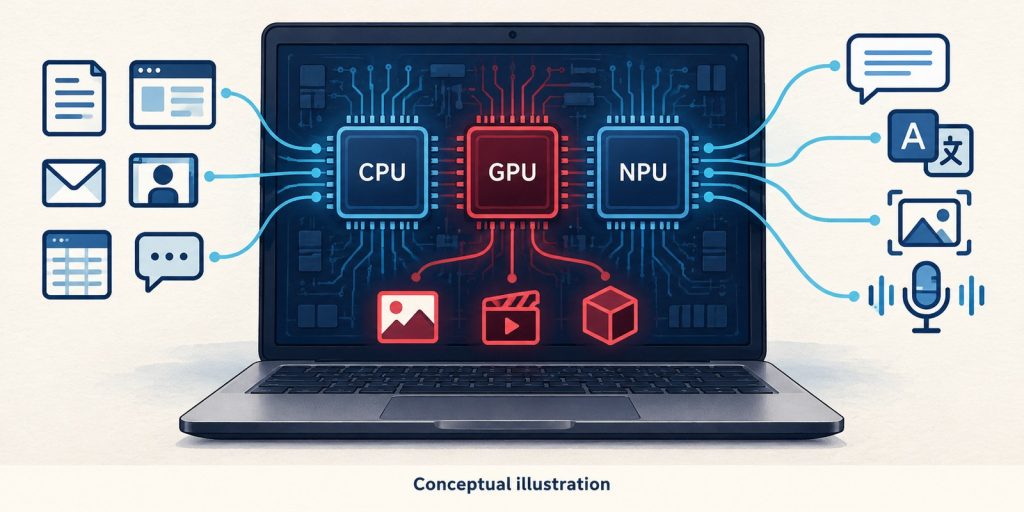
AMD’s Ryzen AI 400 laptop lineup is an update to its Zen 5-based platform, not one uniform level of performance. AMD’s January specifications range from a four-core Ryzen AI 5 430 to the 12-core, 24-thread Ryzen AI 9 HX 475. The top model carries the family’s advertised 60-TOPS NPU; several smaller models list 50 TOPS. (Advanced Micro Devices, 2026)
The graphics differ substantially too. AMD specifies Radeon 890M graphics with 16 compute units for the HX 475, against Radeon 840M graphics with four compute units for the six-core Ryzen AI 7 445. A shared family name therefore does not identify the same CPU, graphics capability or AI accelerator rating. (Advanced Micro Devices, 2026)
Notebookcheck’s Ryzen AI 9 465 analysis used an Asus Zenbook S16 with Radeon 880M graphics, LPDDR5x-8533 memory and 45/35-watt power limits. It described a small refresh over Ryzen AI 300, with competitive multithreaded behavior at restrained power. The publisher’s English edition credits AI translation using DeepL and may not be fully accurate. (Osthoff, 2026)
A different machine produced a different caution. In a June preliminary hands-on report, PCWorld’s Mark Hachman tested an Acer Swift Go 16 AI with the six-core Ryzen AI 7 445. He reported roughly 45% lower application/CPU performance and 29% lower graphics performance when unplugged. Those are observations from that laptop, not measured losses for the entire Ryzen AI 400 family. (Hachman, 2026)
The PCWorld report was explicitly a first look and deferred full battery scores. Notebookcheck’s higher-tier configuration cannot independently confirm the Acer result, because the processor, graphics and chassis differ. PartialMedia has not run its own laptop tests, and neither report alone proves that a bigger NPU makes ordinary CPU work faster. (Hachman, 2026) (Osthoff, 2026)
Editorial Opinion
The AI badge is a poor substitute for the model number. A calm, efficient office laptop and a graphics-heavy creator system may share a processor family while serving different needs. The reviewers’ differing impressions are not a demonstrated contradiction: they tested different products, and one report was preliminary. Look for sustained and unplugged results for the exact machine, then ask whether your intended AI software actually uses its NPU.
References
Advanced Micro Devices. (2026, January 5). AMD expands AI leadership across client, graphics, and software with new Ryzen, Ryzen AI, and AMD ROCm announcements at CES 2026. https://d1io3yog0oux5.cloudfront.net/_0b02c00311273eb0beadd9329f75d125/amd/news/2026-01-05_AMD_Expands_AI_Leadership_Across_Client_Graphics_1270.pdf
Hachman, M. (2026, June 18). The first Ryzen AI 400 laptop I tested is built for focus, not fireworks. PCWorld. https://www.pcworld.com/article/3167314/first-look-amd-ryzen-ai-400-productivity-laptops-may-be-just-okay.html
Osthoff, A. (2026, January 26). AMD Ryzen AI 400 performance analysis: Gorgon Point debuts with only minor improvements. Notebookcheck. https://www.notebookcheck.net/AMD-Ryzen-AI-400-Performance-Analysis-Gorgon-Point-debuts-with-only-minor-improvements.1211982.0.html