Science & Technology | Research cutoff: October 24, 2026, 13:40 UTC
The spacecraft has completed an early operations milestone. Collecting material from Phobos and returning it to Earth remain ambitious future tasks.
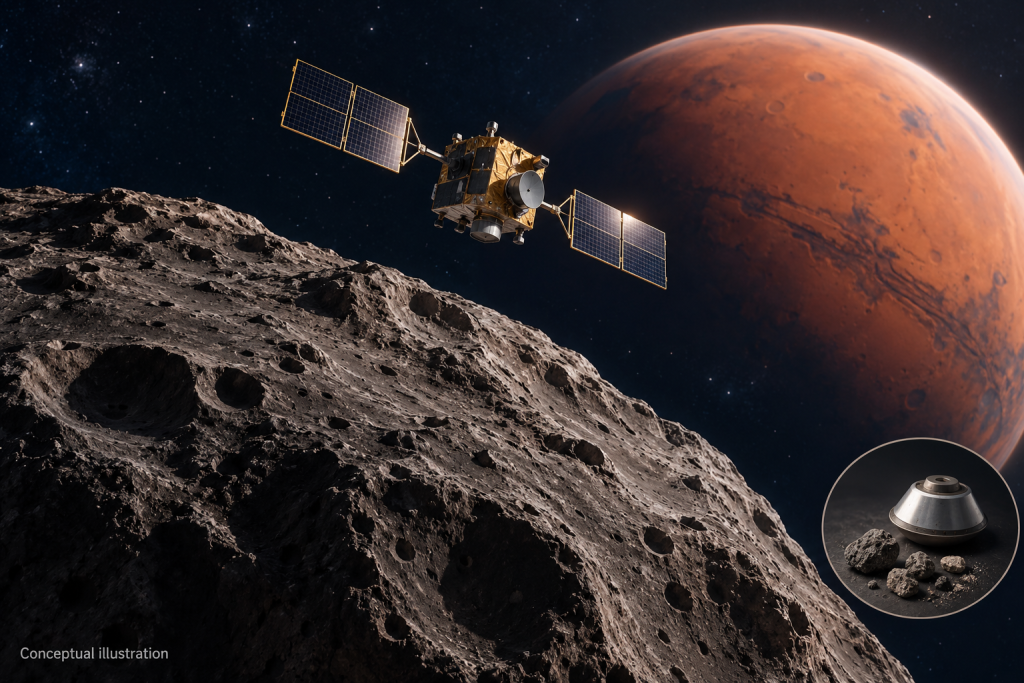
Japan’s Martian Moons eXploration spacecraft, known as MMX, has completed its initial critical operations phase and is in good health, the Japan Aerospace Exploration Agency said October 21. JAXA said it would next check onboard equipment while preparing for the outbound cruise. The announcement follows launch from Tanegashima on October 20 in Japan, which was still October 19 in UTC. It establishes an early spacecraft milestone, not arrival at Mars or successful sample collection. (Japan Aerospace Exploration Agency [JAXA], 2026; European Space Agency [ESA], 2026)
For a lay reader, the milestone is about a spacecraft becoming ready to function after leaving its rocket. JAXA’s critical sequence included opening its solar arrays, establishing control of its orientation on three axes, and releasing a restraint on its medium-gain antenna. These are preparatory operations for power, pointing and communications. The agency’s short release reports completion of that sequence; it is not a published independent performance test or proof that every later maneuver will succeed. (JAXA, 2026)
The scientific objective reaches beyond collecting an unusual souvenir. NASA describes MMX as a mission to study both Martian moons, Phobos and Deimos, and bring a Phobos sample to Earth to investigate their origins and evolution. Two competing explanations are that the moons formed from material thrown into orbit by a major impact on Mars, or that they began as captured asteroids. ABC News’s Natalie Whiting and Akane Saiki explained those alternatives in their reporting from the launch site. The returned material could help test those explanations; the launch itself settles neither. (NASA, n.d.; Whiting & Saiki, 2026)
The mission divides the surface work between different machines. The German Aerospace Center says the French-German Idefix rover is intended to examine Phobos’s surface and help prepare for the main spacecraft’s landing. The main spacecraft, rather than the small rover, is intended to collect the material that a return module would carry to Earth. DLR’s current timeline places the rover landing in 2029 and sample return in 2031. These remain program targets. In ABC’s interview, MMX project team member Yaji Kentaro identified weak surface gravity as a particular landing challenge. (German Aerospace Center [DLR], n.d.; Whiting & Saiki, 2026)
MMX is also a cooperation project: JAXA leads it, DLR and France’s CNES provide the rover, and ESA contributes communications equipment and ground-station support. The next meaningful checkpoints will be further spacecraft checks, arrival and operations near the moons, surface work, and eventual return of material for laboratory analysis. Agency descriptions establish the intended architecture and announced progress. They cannot yet demonstrate a successful Phobos landing or produce scientific findings from a sample that has not been returned. (DLR, n.d.; ESA, 2026; JAXA, 2026)
Editorial Opinion
This is a mission worth following one milestone at a time. A successful launch and a healthy spacecraft are substantial engineering achievements, while the most demanding scientific payoff is still years away. Coverage should give readers both the excitement and the distance left to travel. The most useful celebration now is an explanation of the questions MMX could answer, paired with a clear account of the work still required.
The source descriptions also need scrutiny: ABC describes a rover collecting samples, while DLR assigns collection for Earth return to the main spacecraft. This article follows DLR’s technical account. That apparent conflict deserves clarification rather than repetition as settled fact. (DLR, n.d.; Whiting & Saiki, 2026)
References
European Space Agency. (2026, October 20). MMX lifts off to Mars’s moon Phobos. Mission launch account
German Aerospace Center. (n.d.). MMX and Idefix®—Exploring the Martian moons. Retrieved October 24, 2026, from DLR’s mission description
Japan Aerospace Exploration Agency. (2026, October 21). Completion of the initial critical operations phase of the Martian Moons eXploration (MMX) spacecraft. JAXA operations update
NASA. (n.d.). MMX. Retrieved October 24, 2026, from NASA’s mission description
Whiting, N., & Saiki, A. (2026, October 20). Japan launches first mission to collect samples from Martian moon. ABC News. Original reporting from Tanegashima